84 Ghats Boat Tour Price & Booking
TL;DR — price first:
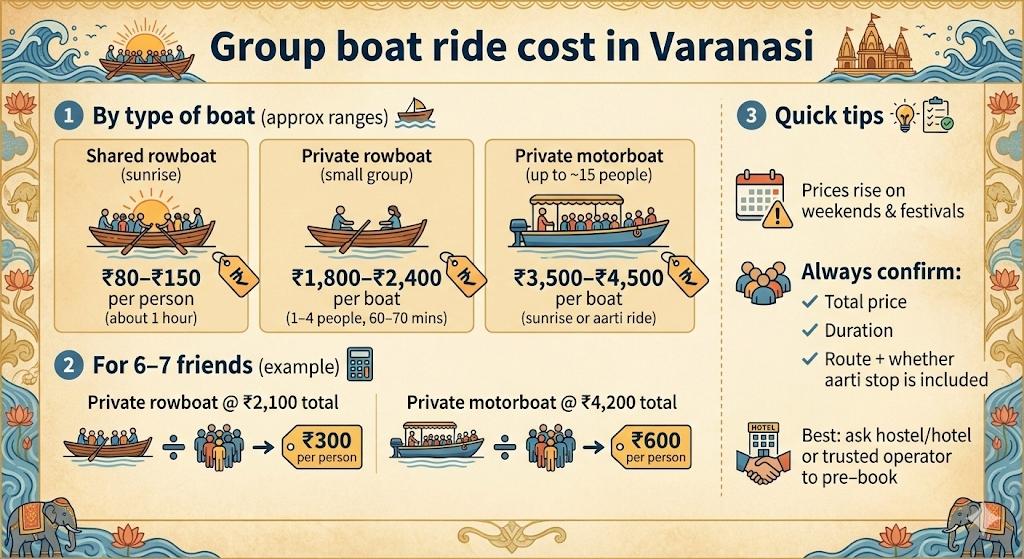
- Private rowboat (2.5 hr) → ₹3,000–₹5,000
- Private motorboat → ₹4,000–₹8,000
- Shared seat → ₹200–₹400 per person
- Assi → Namo full sweep → ₹4,500–₹7,000 private motorboat
Short sunrise loop only? See morning boat ride prices.
Why People Book the 84 Ghats Tour
You want more than a 20-minute aarti float. This run is for the full riverfront — major ghats, Manikarnika from the water, and time to actually look. Traditional pilgrim lore talks of 84 main ghats (of about 88 named ones); operators use “84 ghats” as the long-route label.
84 Ghats Boat Tour Price List
| Tour type | Duration | Typical fare |
|---|---|---|
| Shared group seat | ~2–2.5 hr | ₹200–₹400 / person |
| Private rowboat (4–6) | ~2.5 hr | ₹3,000–₹5,000 |
| Private motorboat (≤15) | ~2.5–3 hr | ₹4,000–₹8,000 |
| Assi → Namo one-way sweep | 2.5–4 hr | ₹4,500–₹7,000 motorboat |
| Festival (Dev Deepawali etc.) | same | 2–4× — book early |
Book: WhatsApp +91 99354 74730 with date, headcount, sunrise vs sunset, and whether you need taxi pickup at the end ghat.
The 84 Ghats Concept
Historical Overview: How Varanasi Built Its Ghat System
Timeline:
- Pre-1700: Varanasi existed, but ghats were natural riverbanks (no stairs)
- 1738–1748: Peshwa Balaji Baji Rao (Maratha ruler) funded construction of first permanent, structured ghats
- 1760–1774: Maharani Ahilyabai Holkar (Indore queen) rebuilt ghats with architectural precision—designing drainage, step angles, temple placements
- 1800–1850: Various Maharajas (local kings) funded ghat additions in honor of their lineages
- 1900–1965: British colonial period saw some ghat maintenance; post-independence, government formalized the "84 ghats" designation
- 2000–2026: Modern renovations (electricity, safety rails, Corridor project) without changing spiritual essence
Current reality: There are actually 88 named ghats, but 84 are considered "main ghats" in traditional pilgrimage routes. The 4 additions (Na Mo Ghat, Buddha Ghat, Tathagat Ghat, Nishad Ghat) were built post-1970s and aren't included in the classical enumeration.
Why 84 Is Spiritually Significant
According to Hindu cosmology:
- 12 Zodiacs (Rashi) represent the annual cycle
- 7 Chakras/Atmosphere layers represent spiritual elevation
- 12 × 7 = 84 sacred points on the cosmic wheel
The belief: Pilgrims who bathe at all 84 ghats complete a full cosmic journey, aligning their soul with universal consciousness, thus achieving moksha.
Practical result: This philosophy drives the 84-ghat boat tour industry. Most pilgrims can't physically bathe at all 84 in one visit, but a boat tour allows viewing all main ghats in 2–3 hours.
Major Ghats on the Tour
North Section: Assi to Dashashwamedh (Starting Point)
Assi Ghat (#1 – Starting point)
- Significance: Confluence of Assi River with Ganges (creates spiritual whirlpool effect)
- When to arrive: 4:45 AM (sunrise boat tours depart here)
- What you'll see: Early morning yoga, pilgrims bathing, temple bells
- Boat stop duration: 5–10 min
Tulsi Ghat (#4)
- Significance: Birthplace of poet Tulsidas (wrote Ramcharitmanas, Hindu scripture)
- Notable: Tulsi's handprints supposedly impressed in stone (sacred relic)
- Boat stop duration: 3–5 min
Hanuman Ghat (#19 & #20)
- Significance: Two versions—Old Hanuman and Prachina (Ancient) Hanuman dedicated to the monkey god
- What distinguishes: Smaller temple, local favorite, less touristy
- Boat stop duration: 5 min
Dashashwamedh Ghat (#41 – Central Landmark)
- Significance: Most sacred ghat (Brahma's 10 horse sacrifices)
- Evening spectacle: Ganga Aarti (5:30 PM winter, 7:00 PM summer)
- If on extended tour ending at aarti: Boat arrives just as ceremony starts
- Boat stop duration: 10–15 min (stop longer if aarti is happening)
Central Section: North of Dashashwamedh (The Sacred Mile)
Rajendra Prasad Ghat (#43)
- Significance: Named after India's first President; logistics hub for boat operations
- Why important: All boats dock here for group tours; largest boat parking area
- What you'll do: Likely your actual boarding/disembarking point
- Boat stop duration: 2 min (unless you're starting/ending tour here)
Man Mandir Ghat (#44)
- Significance: Astronomical observation site built by Maharaja Jai Singh II (18th century)
- Architecture: Ornate palace structure overlooking river; Hindu-Islamic design fusion
- Historical note: Jai Singh was an astronomer-king; he built similar observatories in Delhi and Jaipur
- Boat stop duration: 5 min
Manikarnika Ghat (#53 – Cremation Site)
- Significance: Primary cremation ghat; where Hindu funeral pyres burn 24/7
- Spiritual meaning: Cremation in Ganges believed to grant moksha (soul liberation)
- Tourist protocol: View respectfully from boat (no photos, silence, modest conduct)
- What you'll observe: Funeral rites, family members, wood vendors, priests chanting
- Reality check: It's solemn, not morbid. Cremation is seen as sacred, not dark
- Boat stop duration: 10–15 min (guides usually explain cremation process from boat)
Scindia Ghat (#55)
- Significance: Named after Scindia royal family; architectural marvel
- Notable: Temple partially submerged (illustrates Ganges erosion over centuries)
- Photography: Popular spot (temple towers reflected in water)
- Boat stop duration: 5 min
South Section: Downstream to Ramnagar Fort
Panchaganga Ghat (#67)
- Significance: Believed to be the "five rivers" confluence point (Ganga + 4 others merging spiritually)
- What to observe: Cluster of temples, intricate architecture
- Boat stop duration: 5 min
Durga Ghat (#68)
- Significance: Dedicated to Goddess Durga (warrior form of Shakti); multiple temples
- Cultural note: Durga Puja festivals here attract thousands
- Boat stop duration: 5 min
Ramnagar Fort Ghat (Extended tour endpoint)
- Significance: 18th-century royal palace of Kashi Naresh (Maharaja of Benares)
- Architecture: Red sandstone, Mughal-Hindu fusion style
- Museum: Veda Vyasa temple, antique collections (open for tours)
- Access: The Ramnagar Fort boat ride Varanasi takes 60–90 minutes from Dashashwamedh
- Optional: Disembark, tour fort (2 hours), return by taxi
- Boat stop duration: 15–30 min (if you choose to disembark)
Namo Ghat (Furthest Endpoint — Assi to Namo Ghat Sweep)
Namo Ghat
- Significance: The newest ghat in Varanasi, built under the Namami Gange river-cleaning project; sits near Rajghat, at the far northern end of the ghat chain — the opposite endpoint from Assi Ghat
- Why boaters ask about it: An Assi Ghat to Namo Ghat boat ride is the longest possible one-way stretch on the Varanasi riverfront, covering the entire span of ghats end to end
- What you'll see: Wide, open ghat with amphitheatre-style seating, far fewer crowds than the central ghats, good river views back toward the old city skyline
- Boat stop duration: 10–15 min if you disembark; most boats simply turn around here or arrange a taxi pickup
- Access: Because Namo Ghat is a one-way point-to-point trip rather than a loop, plan your return by road — WhatsApp us and we'll arrange a taxi to meet your boat at Namo Ghat
Boat Tour Types & Logistics
For your varanasi ghat tour by boat, choose from these options based on time and budget:
Tour Option 1: Quick Ghat Loop (1 Hour)
Route: Dashashwamedh → Manikarnika → Scindia → back to Dashashwamedh Best for: Tight schedules, afternoon visitors, those focused on cremation ghat understanding Boat type: Shared motorboat Pricing: ₹250–300 per person (₹2,000–3,000 total for group of 8) Departure windows: 4:00 PM, 6:00 PM, 7:00 PM (flexible) Language: Guide narration in English/Hindi (basic)
Tour Option 2: Standard Extended Tour (2.5 Hours)
Route: Assi Ghat → Dashashwamedh → Manikarnika → Scindia → Ramnagar Fort → back to Dashashwamedh Best for: Half-day experience, cultural explorers, photographers Boat type: Private motorboat (6–15 people) or shared motorboat Pricing per person: ₹400–600 (shared) or ₹350–500 (private group split) Departure windows: 5:15 PM winter (arrives Dashashwamedh at 5:30 PM aarti), or 8:00 AM morning (sunrise loop) Language: Detailed guide commentary (30–40 min of narration) Includes: Water bottles, light snacks
Tour Option 3: Full Pilgrimage Tour (3–4 Hours)
Route: Assi → all 15 major ghats → Ramnagar Fort → return via evening aarti (if timed right) Best for: Spiritual pilgrims, multi-day visitors, those wanting comprehensive understanding Boat type: Private motorboat (best for comfort) Pricing: ₹3,500–4,500 (can split among 8–10 people = ₹350–500 per person) Departure: 4:30 PM winter (timed to end at 5:30 PM aarti), or 3:00 AM morning (sunrise + extended coverage) Includes: Guide expertise (60+ min narration), history of each ghat, mythology stories, tea/snacks Value-add: You visit MORE ghats than typical tours, gain deeper cultural knowledge
Tour Option 4: Photography-Focused Tour (3 Hours)
Route: Sunset boat loop hitting 8 major ghats with photo stops Best for: Photographers, Instagram-focused travelers, visual storytellers Boat type: Private motorboat (flexibility to stop longer) Pricing: ₹2,500–3,500 Timing: Depart 5:00 PM, capture golden hour on multiple ghats, end at Dashashwamedh aarti lighting Includes: Guide who knows photo angles, waits at scenic spots for optimal light (10–15 min per ghat)
Tour Option 5: Assi Ghat to Namo Ghat Full Sweep (One-Way, 2.5–4 Hours)
Route: Assi Ghat → all major ghats → Namo Ghat (Rajghat area, northern endpoint) — no return loop Best for: Travelers who want to cover the entire riverfront in one continuous ride rather than a there-and-back loop Boat type: Private motorboat (recommended for a long one-way trip); shared departures run only in peak/festival season Assi Ghat to Namo Ghat boat ride price: ₹4,500–7,000 private (₹450–700/person split across 8–10 people); ₹350–500/person on shared departures when available Assi Ghat to Namo Ghat boat ride timings: Best at sunrise (5:00–6:30 AM) for calm water and light traffic, or sunset (4:30–5:30 PM winter) for golden-hour views; avoid mid-day heat and monsoon afternoons Fare/cost note: This route costs 15–20% more than the standard loop tours above because it's point-to-point (the boat and boatman must return empty or you arrange a one-way charter) Return: Book a taxi pickup at Namo Ghat in advance — WhatsApp +91 99354 74730 with your date and headcount and we'll coordinate the boat + return taxi together
Group Booking & Discount Structure
Pricing By Group Size
| Group Size | Per Person Cost | Total Cost | Boat Type | Best for |
|---|---|---|---|---|
| 1–2 people | ₹2,000–2,400 | ₹2,000–4,800 | Private rowboat | Couples, quiet experience |
| 3–4 people | ₹1,200–1,500 | ₹3,600–6,000 | Small motorboat | Families, friends |
| 5–8 people | ₹500–700 | ₹3,500–5,000 | Shared motorboat | Larger families, tour groups |
| 8–15 people | ₹300–400 | ₹3,500–5,000 | Private motorboat (split cost) | Hotel groups, pilgrim groups |
| 15+ people | ₹200–350 | ₹5,000–7,000 | Multiple boats or bajra | Organizations, large groups |
Group booking bonus: Groups of 10+ often qualify for 10–15% discount + dedicated guide + complimentary snacks.
Booking Timeline & Strategy
1 week in advance: Best pricing (₹300–400 per person for mid-size groups) 3 days in advance: Standard pricing (₹400–500 per person) 1 day in advance: Premium pricing (₹500–700 per person) + availability not guaranteed Same-day: Rarely possible; typically only shared motorboats available
Festival periods (Nov 24 Dev Deepawali, Nov 24 Kartik Purnima): Book 5–7 days in advance; prices 3–6x higher (₹1,500–2,500 per person).
Group Booking Process (Kashi Taxi)
Step 1: Calculate headcount (include children; ask if special needs require accommodations)
Step 2: Message WhatsApp +91 99354 74730:
"Extended ghat tour, [date], [headcount], [time preference], [budget], [special requests]"
Example: "84 ghats tour, Dec 15, 10 people, sunset departure 5:00 PM, ₹400/person budget, one elderly person with mobility concerns"
Step 3: Receive confirmation with:
- Exact boat assigned
- Boatman name & contact
- Hotel pickup time (if requested)
- Group-specific guide details
- Itinerary with ghat stop sequence
- Payment method (advance deposit vs. day-of)
Step 4: Day-of checklist
- Confirm headcount 24 hours prior
- Sun protection (hat, sunscreen)
- Bring small donation (₹100–200 for cremation ghat guides, if inspired)
- Camera with fully charged batteries
- Water bottle (bring your own or buy ₹20 at ghat)
Boat Ride Experience (Practical Details)
What to Expect During the Tour
Boarding (5 min): Life jacket fitting (insist on it), safety briefing, seating arrangement
Positioning (10 min): Boat moves to first ghat, engine off, guide begins narration
Ghat-by-ghat stops (15–20 min per major stop):
- Guide points out temple details, explains mythology
- You photograph, ask questions, absorb atmosphere
- Boat slowly moves downstream to next ghat
- At cremation ghats, respectful observation (no photos, silence)
Ramnagar Fort (if included): 15–30 min optional disembarkation (many tours skip this to avoid time crunch)
Dashashwamedh aarti finale (if timed right): Arrive exactly at 5:30 PM ceremony start; witness from water vantage point
Return (5–10 min): Boat returns to Rajendra Prasad Ghat (official dock); you disembark
Total time on water: 120–180 minutes depending on tour type
Safety Protocols
Life jackets: Mandatory (request in advance if you have size concerns) Boat capacity: Never overloaded (weight limits strictly enforced) Boatman experience: All operators minimum 5+ years experience Weather cancellation: Monsoon boats may be cancelled morning-of if water too rough Insurance: Kashi Taxi boats carry liability insurance (standard in tourism industry)
Weather Impact on Tours
Winter (Oct–Mar): Ideal boating (calm water, clear skies, 70–75°F) Summer (Apr–Jun): Manageable (hot, 95–105°F, but water still calm) Monsoon (Jul–Sep): Risky (rough water, daily thunderstorms, 50% chance of rescheduling)
Recommendation: Book tours Oct–Mar for maximum reliability and comfort.
Photographic Opportunities
Best Light Windows for Photography
Golden Hour (Sunset): 5:00–6:30 PM winter
- Temple architecture glows warm
- Water reflections intensify
- Crowd activity peaks (good for people photography)
- Best ghats: Dashashwamedh, Scindia, Panchaganga
Blue Hour (Dusk): 6:30–7:00 PM winter
- Sky transitions from orange to indigo
- Lights on temples begin flickering on
- Atmospheric, moody feeling
- Best for: Artistic, dramatic compositions
Early Morning (Sunrise): 6:00–7:00 AM
- Mist rises from river
- Temples silhouetted
- Pilgrims bathing (human interest photography)
- Best ghats: Assi, Dashashwamedh, Manikarnika
Photography Restrictions (Respect Protocol)
Allowed:
- Temples, ghat architecture, landscapes
- Pilgrims (if they don't object)
- Sunrise/sunset scenes
- River reflections
- Boat-based distant shots
Prohibited:
- Close-up photography of cremations
- Photos of grieving families
- Disrespectful angles or mocking
- Flash photography in temples
Enforcement: Temple police may request deletion if you violate. Respect local culture; you're a guest.