This guide is written for:
- First-time pilgrims: Who want to understand the temple's significance before arriving
- Returning seekers: Who want to deepen their practice and experience
- Curious travelers: Who want spiritual depth alongside cultural tourism
Unlike secular tourist guides, this page honors the temple's sacred purpose while providing practical logistics.
Need a Finished Package, Not Just the Guide?
If your question is "who can plan the darshan, pickup, lockers, boat option and evening Aarti flow for us?" then use the booking guide:
If the package also needs hotel or family pacing, then use:
Kashi Vishwanath Temple Significance
What Makes Kashi Vishwanath “The Holiest”?
In Hinduism, there are four primary pilgrimage destinations called "Char Dham" (four abodes):
- Varanasi (Kashi) — Kashi Vishwanath Temple
- Rishikesh — Badrinath Temple
- Dwarka — Dwarkadhish Temple
- Rameswaram — Ramanathswamy Temple
Of these four, Kashi Vishwanath is considered the supreme gateway to moksha because of a specific theological concept.
The Jyotirlinga Principle
"Jyotir" = light; "Linga" = form of Lord Shiva
There are 12 Jyotirlingas (supreme manifestations of Shiva) across India. Kashi Vishwanath is not just one of the 12—it's the most accessible to pilgrims, located in the holiest city (Kashi), on the holiest river (Ganga), making it the most spiritually concentrated location.
Hindu belief: The Jyotirlinga represents Shiva in his pure, formless light. Witnessing it (darshan) in this location is believed to purify the soul of karmic debt.
The Moksha Concept Explained
Moksha (also spelled "Mukti") means liberation from the cycle of birth-death-rebirth (samsara). Hindu philosophy sees physical life as temporary; the goal is spiritual freedom.
Why Kashi Vishwanath grants moksha:
- Lord Shiva is believed to reside here permanently (not just visited, but dwelling)
- Simply dying in Kashi and having one's ashes immersed in the Ganges here grants moksha (the ultimate Hindu belief)
- This isn't reserved for the wealthy or enlightened—even an ordinary person's death here is spiritually liberated
- Therefore, pilgrimage here while alive is seen as preparation for that ultimate moment
Practical implication for your visit: This isn't a casual sightseeing location. Approach with reverence. Local pilgrims believe their presence here influences their spiritual destiny.
Historical Timeline (800 Years of Continuous Worship)
1100 CE (Approximate): Original temple believed built by King Chandradeva. Destroyed and rebuilt multiple times during Muslim rule (when Hindu temples were often targeted).
1776: Current temple structure rebuilt by Maharani Ahilyabai Holkar of Indore (the same female ruler who rebuilt Dashashwamedh Ghat). Her version is the foundation of today's temple.
1835: Gold plating donated by Maharaja Ranjit Singh of Punjab—the temple's gold dome becomes iconic.
1991–2007: "Shringar Mandir" (beautification project) modernizes access, improves security, preserves sanctity.
2021: Kashi Vishwanath Corridor opens—modern walkway connecting temple to Dashashwamedh Ghat. A ₹339 crore ($50 million USD) development project.
2026 Current Status: Active, well-maintained, receiving 10,000–15,000 pilgrims daily (30,000+ on festival days).
Temple Darshan Process
Darshan Types & Timing (Multiple Entry Options)
Understanding the Kashi Vishwanath darshan time options helps you plan efficiently. The Kashi Vishwanath temple darshan procedure varies based on which darshan type you choose.
Type 1: General (Sthul) Darshan
- Cost: Free
- Duration: 30 minutes–2 hours depending on crowd
- Timing: 4:00 AM–11:00 PM daily
- Process: Queue with other pilgrims, pass security, enter temple, view Shivling, receive prasad
Type 2: Sugam Darshan (Recommended for first-timers)
- Cost: ₹300–500
- Duration: 10–15 minutes total
- Timing: 6:00 AM–6:00 PM daily
- Benefits: Dedicated entry, Shastri (priest) accompaniment, faster access, special prasad
- How to book: Online at shrikashivishwanath.org or at temple counter
Type 3: Aarti Darshan (Special experience)
- Cost: ₹500–1,000 (depends on aarti type)
- Times: Mangala Aarti (5:45 AM), Bhog Aarti (11:15 AM), Sandhya Aarti (7:15 PM), Shringaar Aarti (9:00 PM)
- Duration: 30 minutes (aarti itself) + 15 min darshan = 45 min total
- Benefit: Witness priest performing rituals directly
- Booking: Online 1 week in advance recommended
Step-by-Step Darshan Process (First-Timer’s Guide)
Kashi Vishwanath Dham 4-Gate Access Map
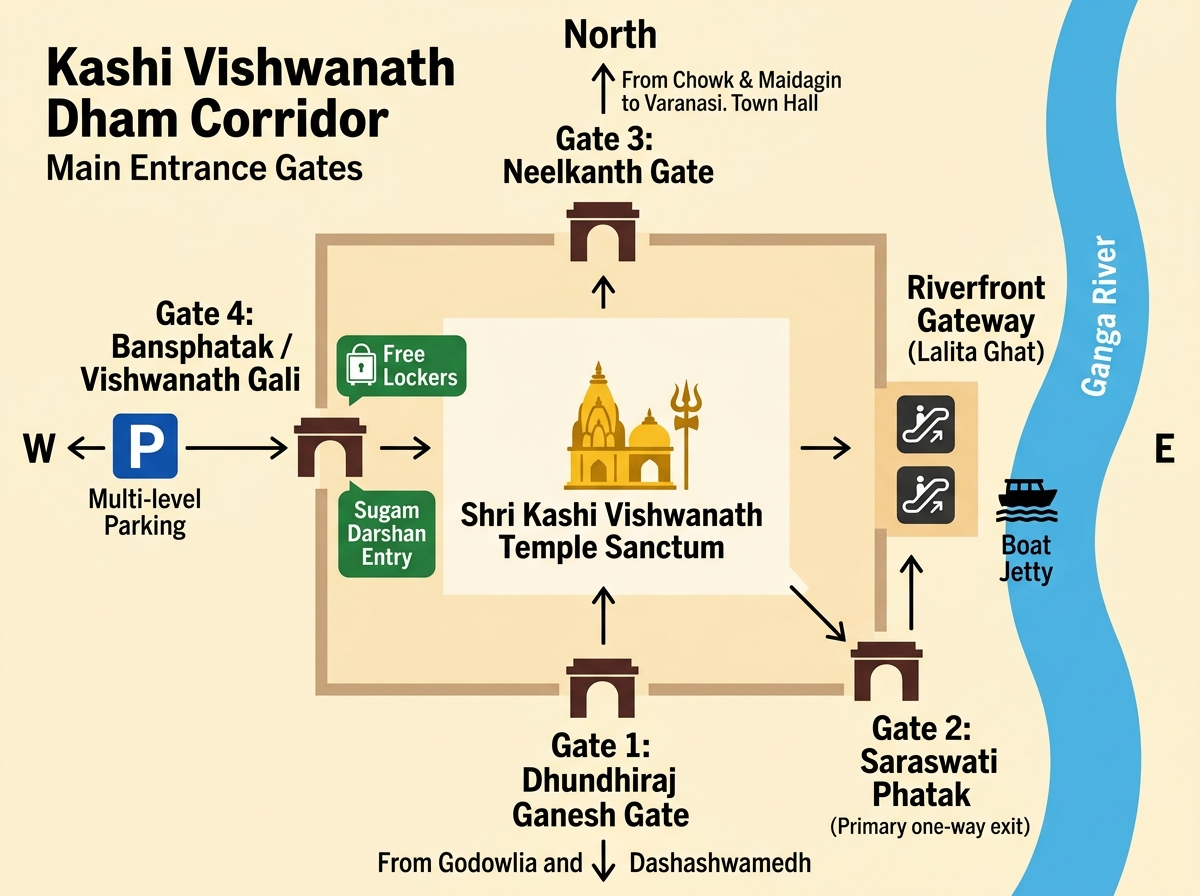
- Gate 4 (Bansphatak / Vishwanath Gali): Primary western entrance with the largest official free locker facility and Sugam Darshan entry counter. Nearest cab drop is Benia Bagh multi-level parking.
- Gate 1 (Dhundhiraj Ganesh): Southern entrance accessible from Godowlia crossing and Dashashwamedh Ghat.
- Gate 3 (Neelkanth): Northern entrance coming down from Chowk and Maidagin Town Hall parking.
- Gate 2 (Saraswati Phatak): Designated one-way exit route out to the bazaar lanes.
- Riverfront Gateway (Lalita Ghat): Connects directly to the Ganga ghats via escalators and the pilgrim boat jetty.
Step 1: Arrival (Plan 30–45 min travel)
- From hotel, take taxi/auto to "Kashi Vishwanath Temple Corridor" drop point
- Four primary gates connect into the Dham: Gate 1 (Godowlia), Gate 2 (Saraswati Phatak exit), Gate 3 (Neelkanth), Gate 4 (Bansphatak)
- First-timers: Enter via Gate 4 (clearest signage, dedicated Sugam counter, largest locker bank)
Step 2: Belongings Management (5 min)
- Mobile phones, cameras, leather belts, and cigarettes are strictly prohibited inside the inner sanctum
- Shoes removed at official shoe counters
- Valuables and phones can be deposited inside the official free locker desks at Gate 4 and Gate 1 (avoid street touts demanding expensive locker rentals or forced prasad bundles)
- Carry: Small prayer book (optional), simple floral basket from local vendors
Step 3: Security Screening (10–15 min)
- Police-managed metal detector
- Pat-down check
- Bag inspection (if carrying bag)
Step 4: Entry Queue Management (Varies 15 min–2 hours)
- Separate lines: General, Sugam Darshan, VIPs, priests
- Move in single file down narrow corridor
- Priest/volunteer directs queuing (follow their hand gestures)
Step 5: Shivling Darshan (30 seconds–2 min)
- You reach the main sanctum (garbha griha = innermost sacred chamber)
- The Shivling (stone phallus symbol of Shiva) is before you
- Bow, make silent prayer/wishes, offer flowers if carrying
- Priest may apply tilak (mark) on forehead
- Move forward; don't linger (hundreds waiting behind you)
Step 6: Prasad Distribution (1 min)
- Exit the temple
- Priest or volunteer hands you sacred food (typically sugar/jaggery candy, or wheat porridge)
- Consume immediately or save as blessed offering
Step 7: Post-Darshan Reflection (5–10 min)
- Walk to nearby café or ghat
- Sit, reflect on your experience
- Many pilgrims cry here (emotional release common after darshan)
- Perfectly normal and respected
Total time in temple: 45 minutes–2.5 hours (depending on crowd and whether you arrive during peak hours)
Best Times for Shorter Queues
Weekday mornings (Mon–Thu, 7:00–9:00 AM): 30 min queue, pleasant atmosphere
Weekday afternoons (Mon–Thu, 1:00–3:00 PM): 20–30 min queue, fewer foreigners
Festival nights (Maha Shivaratri, Janmashtami): Skip entirely; 10+ hour waits
Worst times: Friday–Sunday evenings (tourist surge), festival days (10,000+ person queues)
Kashi Vishwanath Temple Dress Code (What to Wear)
There is no rigidly enforced uniform, but the temple is an active place of worship, so modest, respectful clothing is expected — and dressing right also means a smoother security check.
- Is jeans allowed in Kashi Vishwanath Temple? Yes, clean, non-torn jeans are generally allowed for both men and women. Avoid ripped jeans, very short shorts, or sleeveless/revealing tops.
- Dress code for ladies: Salwar kameez, saree, kurti with leggings, or any outfit that covers shoulders and knees is ideal. A dupatta or light scarf is handy to cover the head inside the sanctum.
- Dress code for men: Full-length trousers or a kurta-pyjama work best; many pilgrims wear a dhoti for aarti darshan. Shorts are best avoided.
- Practical tip: Footwear and leather items (belts, wallets) must be removed/deposited before entry, so wear slip-on shoes and carry minimal metal to speed up the queue.
Getting to the Temple from Varanasi Junction & Airport
Most pilgrims arrive via Varanasi Junction (Cantt) railway station. A shared auto to Godowlia runs ₹30–50 per seat; a reserved auto from the railway station to Kashi Vishwanath Temple is roughly ₹150–250, and a pre-booked taxi that clears the Godowlia corridor barricade is ₹300–500. From the airport it is 25–26 km. For fixed, tout-free fares and corridor drop, see the Varanasi Airport to Kashi Vishwanath taxi guide or WhatsApp 💬 +91 70545 49988.
The Integrated Pilgrimage Itinerary
Combining Kashi Vishwanath temple aarti with ganga aarti kashi creates the complete spiritual experience. Here's how to plan your kashi ganga aarti time for maximum impact.
3-Hour Spiritual Journey (Morning)
6:00 AM: Temple Darshan
- Sugam Darshan booking (₹300–500)
- Fast-track darshan with priest guidance
- Arrive 15 min early; depart by 6:30 AM
6:45 AM: Sacred Ganga Dip (Snan)
- Walk 5 minutes to Dashashwamedh Ghat
- Join pilgrims entering Ganges water
- 2–3 complete immersions (full-body dipping)
- Significance: Washing away karmic impurities; body contact with sacred river
- Duration: 15 minutes
7:00 AM: Morning Boat Ride (Optional)
- Sunrise boat from Assi Ghat (if you started there)
- Or: Immediate return to hotel for breakfast
8:00 AM: Breakfast
- Local restaurant (vegetarian), famous lassi, paratha (bread), halwa
Total journey cost: ₹300–500 (temple) + ₹200–300 (boat optional) = ₹500–800 per person
4-Hour Spiritual Journey (Evening)
4:00 PM: Temple Darshan
- General or Sugam Darshan (₹0–500)
- Arrive by 4:00 PM for afternoon darshan
- Depart by 5:00 PM for river preparation
5:00 PM: Preparation at Ghat
- Walk to Dashashwamedh Ghat (adjacent)
- Obtain flowers for aarti offering (₹50)
- Prepare mentally for evening ceremony
5:30 PM: Ganga Aarti Ceremony
- Watch 45-min evening aarti from ghat standing position
- Or: Boat ride (₹3,500–4,500 for group, ₹250–300 per person shared)
- Witness priests honoring Mother Ganga via fire rituals
6:15 PM: Post-Aarti Blessing
- Surge forward for priest blessing
- Receive blessed flowers/petals
- Optional: Small donation (₹20–100) to temple committee
7:00 PM: Dinner
- Ghat-side restaurant, traditional vegetarian Varanasi cuisine
- Chikhalwali (chickpea curry), puri (fried bread), sweet kheer (rice pudding)
Total journey cost: ₹500–1,000 (temple + boat/ghat) + food = ₹1,000–1,500 per person
Sacred Dip Etiquette & Significance
Why Pilgrims Bathe in the Ganges
The Ganges River is personified as Mother Ganga—a goddess, not just water. Hindus believe:
- Bathing in her waters purifies sin (papa) accumulated over lifetimes
- Full immersion = spiritual rebirth
- This is NOT superstition to Hindus—it's foundational theology
Proper Bathing Procedure (Respectful Protocol)
What to wear:
- Women: Salwar kameez or long dress (easily removed)
- Men: Shorts or light pants
- Footwear: Leave on riverbank with belongings
- Undergarments: Wet-friendly (won't dry fast in cold)
Entry process:
- Find trusted local or hotel staff to watch belongings
- Descend ghat steps slowly (slimy algae = slippery)
- Wade in gradually (water current is surprisingly strong)
- Find stable footing (chest-deep is ideal)
- Complete 2–3 full-body immersions (dunk head underwater completely)
- Exit slowly, same route back up
Post-dip:
- Wring out clothes as much as possible
- Dry with towel brought from hotel
- Change into dry clothes (bring spare set)
- Drink fresh water (not Ganges water—risky microbes despite spiritual belief)
Where to Bathe Safely (Ghat Selection)
Best for beginners: Dashashwamedh Ghat
- Cleanest steps, police presence, manageable crowds
- Morning or afternoon (less crowded than evening)
Avoid entirely: Manikarnika Ghat (cremation site—water polluted by ash + business; disrespectful to bathe here)
Best for spiritually-focused: Assi Ghat
- Smaller crowds, more local pilgrims, deeper sense of community
- Early morning (5:30–6:30 AM) = fewest tourists
Safety Considerations
Water quality warning:
- Ganges has sewage (upstream villages, factories discharge)
- Water-borne pathogens present (despite spiritual purity belief)
- Don't swallow water; keep head above water level if immunocompromised
- Post-bath: Wash hands thoroughly, avoid touching face until dried
Current danger:
- Ganges has strong undercurrents (especially monsoon, post-monsoon)
- Don't venture deep; water can pull you downstream
- Children should be supervised constantly
Health protocols:
- If you have open cuts/wounds: Apply waterproof bandages
- If you have skin infections: Bathe at hotel instead (contagion risk)
- If recently vaccinated: Safe to bathe (no complications)
Aarti Ceremony from Temple Perspective
Mangala Aarti (5:45 AM)
- Significance: "Mangal" = auspicious; first aarti of the day
- Ritual: Priests light lamps to awaken Shiva
- Duration: 20 minutes (shorter than evening)
- Crowd: 100–200 pilgrims (mostly locals)
- Best for: Spiritual seekers, early risers
Bhog Aarti (11:15 AM)
- Significance: "Bhog" = food offering; offering temple meal to deity
- Ritual: Priests present food offerings (vegetarian dishes)
- Duration: 15 minutes
- Crowd: 50–100 people
- Best for: Casual visitors between other activities
Sandhya Aarti (7:15 PM)
- Significance: "Sandhya" = dusk; transition from day to night
- Ritual: Main evening aarti, most elaborate (if priests perform inside)
- Duration: 30–40 minutes
- Crowd: 500–1,000 people (tourists + pilgrims)
- Best for: First-timers wanting full ceremonial experience
Shringaar Aarti (9:00 PM)
- Significance: "Shringaar" = adornment; dressing the deity
- Ritual: Priests dress Shivling in colored silks, jewelry
- Duration: 20 minutes
- Crowd: 100–300 people (evening devotees)
- Best for: Those staying overnight in Varanasi
Night Aartis (Multiple times midnight–4:00 AM)
- Significance: Continuous worship (Kashi Vishwanath never "sleeps")
- Access: Limited (pilgrims only, not open to casual visitors)
- Special request: Contact temple in advance to arrange
Inside-the-Temple Aarti vs. Ghat Aarti (Key Difference)
Confusion point: There are TWO aarti ceremonies in Varanasi that confuse tourists searching for "varanasi aarti time," "kashi me ganga aarti time," or "kashi ganga aarti time":
-
Kashi Vishwanath Temple Aarti (inside temple, small scale)
- Priests perform at altar within sanctum
- 20–40 minute ceremony
- Capacity: 50–100 visible watchers
- Access: Temple darshan ticket (₹0–500)
-
Ganga Aarti at Dashashwamedh Ghat (riverside, grand spectacle)
- Priests perform at ghat altar (not temple)
- 45 minute ceremony
- Capacity: 500–800 people
- Access: Free (standing) or boat (₹200–4,500)
- This is the FAMOUS one (what tourists see on Instagram)
Integration: Many pilgrims do temple darshan in afternoon, then walk 5 min to Dashashwamedh for the evening ghat aarti (two ceremonies, one itinerary).
Spiritual Preparation & Mindset
What to Expect Emotionally
First-time pilgrimage to Kashi Vishwanath is often deeply emotional. Visitors report:
- Overwhelming sense of presence (spiritual or psychological—both valid)
- Sudden tears (energy release common, not pathological)
- Profound peace (post-aarti meditation state)
- Sensory overload (crowds, bells, incense, chanting simultaneously)
Normal reactions: All of the above are expected and respected by locals. You won't be judged for crying, sitting in silence, or expressing emotion.
Meditation Tips Before Darshan
5 minutes before temple entry:
- Find quiet spot (ghat café, hotel room, or quiet lane)
- Sit cross-legged or on bench
- Close eyes, breathe slowly (4-count inhale, 6-count exhale)
- Set an intention: "I come with open heart, seeking spiritual peace" (or your own words)
- Open eyes, enter temple with calm mind
During darshan (in the temple):
- Don't rush to push forward
- Respect others' privacy in their prayers
- If you feel emotional, it's fine to stay a few extra seconds (priests understand)
After darshan:
- Sit at ghat café for 15–30 minutes
- Journal if you brought notebook
- Don't immediately rush into sightseeing
- Allow emotional processing time
Festival Spiritual Intensity (Peak Times)
Maha Shivaratri (February 2026: February 15)
Significance: "Great night of Shiva"; celebrates Shiva's cosmic dance
Pilgrims: 500,000–1 million devotees converge in Varanasi
Darshan wait: 4–8 hours (some all-night vigils)
What happens: Continuous chanting, 24-hour temple opening, sacred fire rituals
Best strategy: Arrive a day early, do darshan morning-of (wait times slightly lower)
Hotel booking: Reserve 2 months in advance (all hotels fully booked)
Kartik Purnima / Dev Deepawali (November 24 & 5)
Kartik Purnima (Nov 24): Sacred bathing day (pilgrims perform snan)
Dev Deepawali (Nov 24): Festival of lamps (1M+ diyas light 84 ghats)
Temple experience: Lighter crowding (people dispersed to ghats for celebrations)
Best for: Spiritual seekers wanting temple + ghat integration
Makar Sankranti (January 14, 2026)
Significance: Sun's transition; major pilgrimage season opener
Darshan: 6–8 hour waits expected
River bathing: 100,000+ pilgrims in Ganges same day
Hotel availability: Book 3 months in advance
Booking Your Spiritual Journey
Temple Darshan Booking
Online:
- Website: shrikashivishwanath.org
- Login, register, book Sugam Darshan slot (₹300–500)
- Receive confirmation & timing window (e.g., 6:00–6:30 AM)
- Arrive 15 min early with confirmation printout
On-site:
- Go to temple counter (Gate 4)
- Ask for "Sugam Darshan ticket" (₹300–500)
- Get same-day appointment slot (usually 30–120 min wait)
- Proceed per slot assignment
Integrated Boat + Temple Booking
For complete 3–4 hour spiritual journey:
- Book boat through Kashi Taxi: +91 99354 74730
- Message: "Temple + boat combo, [date], [time preference], [headcount]"
- Specify: Temple morning darshan (6:00 AM) + afternoon sacred dip + evening boat aarti
- Kashi Taxi coordinates hotel pickup, temple timing, boat departure
- Cost: ₹1,000–1,500 per person (combines all experiences)
Festival Booking (Peak Dates)
Maha Shivaratri, Kartik Purnima, Makar Sankranti:
- Book accommodations 2–3 months in advance
- Book temple aarti darshan 1 month in advance (online)
- Book boats 1 week in advance (premium pricing applies)
Conclusion: The Pilgrimage That Changes Perspective
A visit to Kashi Vishwanath Temple isn't about checking a box on a tourist list. For Hindus, it's the culmination of lifelong faith. For seekers of all backgrounds, it's a encounter with something far larger than yourself—whether you interpret that as divinity, history, human devotion, or personal transformation.
The temple has stood for 900 years. Its priests have chanted the same mantras for centuries. The Ganges has flowed eternally. Your pilgrimage is both infinitesimally small and eternally significant in this continuum.
Approach with humility. Leave with an open heart.