Malaiyo – The Rare Winter Sweet Only Found in December
| Quick Facts | Details |
|---|
| Season | Late Nov – Feb (Dec peak) |
| Best Time | 5:30 – 8:00 AM before sun warms the foam |
| Price | ₹20-50 per kulhad |
| Top Lanes | Thatheri Bazar, Chaukhamba, Godowlia |
| Pairs With | Sunrise yoga at Assi, Banarasi silk shopping walks, Kabira festival mornings |
Availability: Early morning hours only (5:00-11:00 AM)
Best Months: November-February (December peak)
Price: ₹20-50 per serving
Key Locations: Thatheri Bazar, Chaukhamba Lane, near Vishwanath Gali
Season Window: 45-minute lifespan (collapses by late morning)
The Ethereal Delicacy That Defines Varanasi Winters
Malaiyo (also called Makhan Malai or Nimish) is not merely a dessert – it's a seasonal miracle possible only during winter's specific meteorological conditions. A cloud-like foam that appears on milk left overnight under open winter sky, Malaiyo represents the convergence of ancient knowledge, nature's cooperation, and culinary craft.
You'll hear locals call it banaras malaiyo just as often — Banaras being the older, everyday name for the city. Same dessert, same stalls, same winter-only magic.

The Science Behind the Magic
The Process:
- Evening Preparation: Milk is boiled with cardamom and saffron, then poured into wide, shallow vessels.
- Overnight Magic: Left uncovered under clear winter sky, the cold air causes the top layer to ferment and froth.
- Morning Harvest: Between 5-7 AM, before dawn warmth collapses the foam, vendors gently skim the delicate mousse.
- Presentation: Served in small clay cups (kulhads) topped with pistachios, almonds, and sometimes fruit pieces.
- Consumption Window: Must be eaten within 45 minutes before foam collapses.
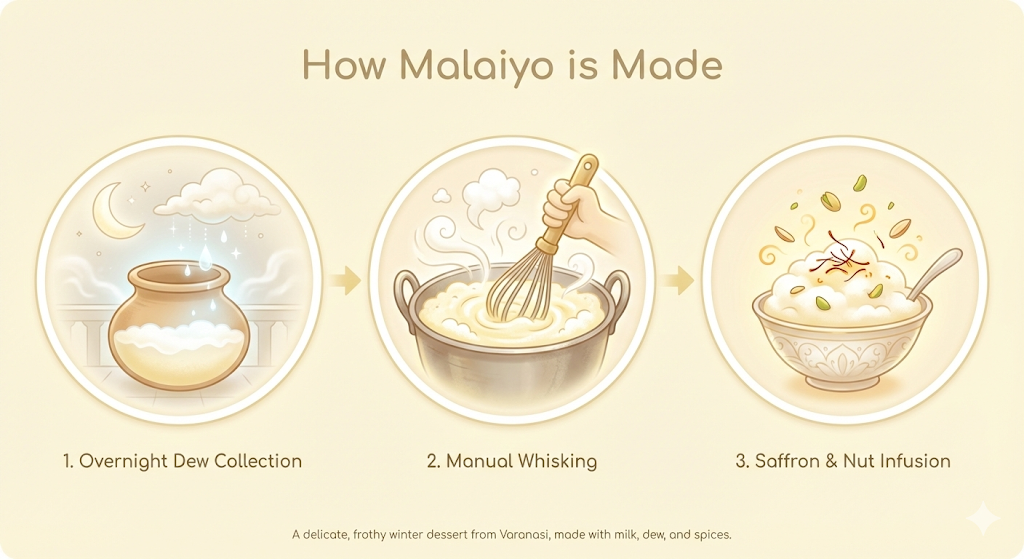 The magical overnight process that creates this ethereal winter dessert.
Why Only in Winter:
- Cold temperatures (8-15°C) slow milk proteins' oxidation.
- Clear skies (no fog) allow proper dew formation.
- Winter dew contains specific moisture content required.
- Spring/summer heat destroys the fermentation process.
- Exact conditions exist only November-February.
Taste Profile & Experience
Flavor: Subtle sweetness with cardamom's warmth and saffron's delicate notes – not sugary, surprisingly sophisticated.
Texture: Eating malaiyo feels like consuming air – mousse dissolves on tongue immediately; the pistachios and almonds provide gentle crunch.
Sensation: Locals describe it as "eating a sweet cloud" – literally weightless, cooling, and supremely satisfying.
Cultural Significance: Tied to Kartik Purnima (November) but continues through early December, representing abundance and nature's gifts.
Where to Find Authentic Malaiyo
Thatheri Bazar
- Location: Old City, heart of artisanal quarter.
- Hours: 5:00-10:00 AM.
- Character: Narrow lanes, traditional vendors, morning energy.
- Authenticity: Very high; locals frequent.
- Experience: Pure, unmercenary transactions.
- Cost: ₹20-30 per serving.
Chaukhamba Lane
- Location: Near Vishwanath Gali, close to Golden Temple.
- Hours: 5:00-9:00 AM.
- Character: More touristy but still authentic.
- Accessibility: Easier walking lanes.
- Experience: Mix of locals and tourists.
- Cost: ₹30-40 per serving.
Godowlia Area
- Location: Market hub south of main ghats.
- Hours: 5:00-11:00 AM (extended).
- Character: Commercial but reliable.
- Reliability: Always available during season.
- Experience: Tourist-friendly.
- Cost: ₹30-50 per serving.
Shreeji Sweets & Other Established Shops
- These established sweet shops also make malaiyo.
- More reliable during off-peak hours.
- Higher consistency in quality.
- Cost: ₹40-50 per serving.
The December Advantage
December Conditions:
- Absolutely pristine malaiyo (September-October fog sometimes compromises early-season product).
- Peak vendor confidence (they've perfected process through November trials).
- Best temperature ranges (not too cold, not warming up).
- Highest demand, therefore freshest product daily.
Best Days:
- December 5-15: Optimal conditions, excellent weather, fewer tourists.
- December 16-22: Still excellent but increasingly crowded as festival visitors arrive.
- December 23-31: Reliable but very touristy, longer waits.
The Cultural Experience
Eating malaiyo isn't transactional – it's participation in Varanasi's seasonal rhythm:
Vendor Perspective:
Many malaiyo vendors are families who've done this for generations. They wake at 2 AM to prepare milk, monitor overnight conditions, and wake at 4 AM to harvest. They see customers as part of their daily ritual, not transactions.
Local Community:
Watching locals eat malaiyo – children playing while grandmothers savor sweet – shows Varanasi's domestic life. You're not observing as outsider but joining a community tradition.
Seasonal Marker:
For Varanasi residents, malaiyo's appearance marks winter officially begun. It's tied to school calendars, family gatherings, and seasonal transitions.
How to Experience Malaiyo Properly
Timing Strategy:
- Wake at 4:45 AM.
- Reach vendor location by 5:15-5:30 AM.
- Order your malaiyo.
- Find comfortable spot (many vendors have small seating areas).
- Eat immediately, savoring each spoonful.
Eating Ritual:
- Observe it before eating – appreciate the ethereal quality.
- Take first spoonful slowly – texture changes rapidly.
- Notice how sweetness emerges gradually (not aggressively sweet).
- Appreciate pistachio and almond crunch contrasts.
- Finish within 5-10 minutes (deteriorates quickly).
Accompanying Experience:
Cost & Budget Considerations
- Per Person: ₹20-50 (extremely affordable).
- Daily Indulgence: ₹50-100 if having multiple servings (locals often do).
- Weekly Budget: ₹200-300 for regular indulgence during December stay or longer festival visits.
- Value Assessment: One of the best food values in Varanasi – unique, delicious, culturally significant.
Alternatives & Variations
Makhhan Malai (Butter Foam):
- Richer version with actual butter.
- Higher fat content.
- Cost: ₹40-60.
- Locations: More selective vendors, higher-end sweet shops.
Flavored Versions:
- Rose malaiyo (rare).
- Mango malaiyo (out of season December).
- Pistachio-enriched versions.
- Usually ₹50-70.
Shop-Made Versions:
- Some established sweet shops prepare under AC, not open-sky.
- Less traditional but reliable.
- Different texture – not exactly authentic.
- Cost: ₹50-80.
- Pro move: Combine with a late-morning Banarasi silk shopping run so you can sample sweets while browsing sarees.
Pro Tips for Maximum Enjoyment
- Ask vendors when they prepared the batch – freshly skimmed is superior.
- Observe weather night before – clear, cold nights produce best malaiyo.
- Go on weekdays if possible – less crowded.
- Bring small portable chair – sitting on rough ground uncomfortable for 10 minutes.
- Photograph immediately upon serving – beauty fades rapidly.
- Ask vendor stories – many have fascinating histories.
- Return daily if possible – variations between days are subtle but interesting.
- Consider buying small packets to take – though texture deteriorates, flavor remains.
- Engage with locals eating nearby – they're often friendly and enjoying their own malaiyo.
- Don't overthink it – the simplicity is the perfection.
Why Malaiyo Captures Varanasi Spirit
Unlike engineered tourist experiences, malaiyo exists because conditions align naturally. It represents:
- Seasonal Attunement: Living with nature's rhythms, not against them.
- Simplicity: Complex taste from basic ingredients and natural processes.
- Tradition: Unchanged method for generations.
- Ephemeral Beauty: Something that vanishes by midday, demanding immediate attention.
- Community: Shared experience transcending class, background, nationality.
Eating malaiyo in December is more than consuming a sweet – it's tasting Varanasi's soul distilled into foam.